
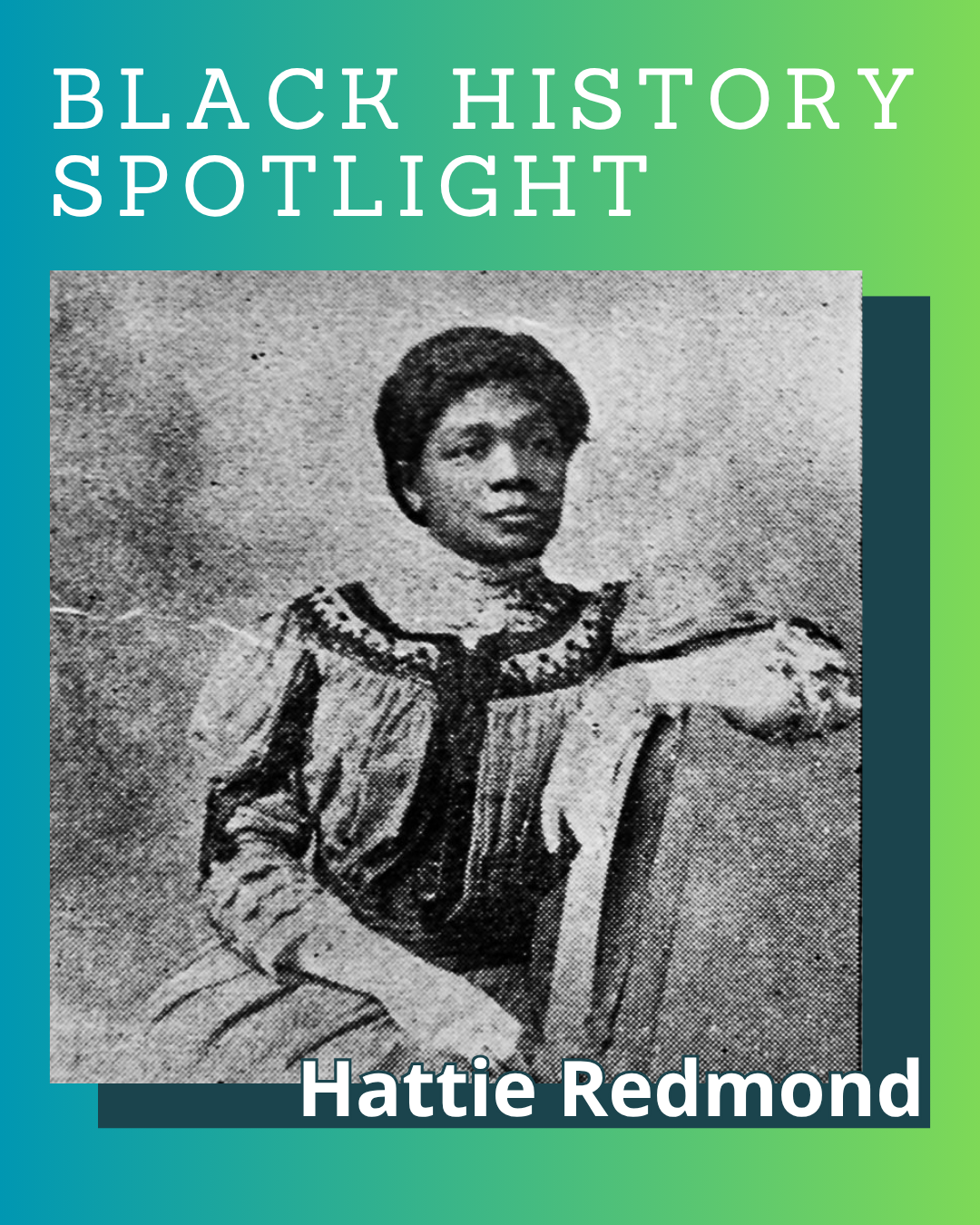
Hattie Redmond was an early Black activist and one of the most prominent members of Oregon’s woman suffrage movement in the 1910s. Harriet “Hattie” Crawford was born in St. Louis Missouri in 1862. Soon after, the large Crawford family traveled overland to Oregon where they settled in Hood River. By 1880, the family was living in Portland. Hattie’s father Rueben was a ship caulker, and a well-known social activist, serving in the Portland Colored Immigration Society and the Republican Lincoln Club.
Not much is known about Hattie’s life in Portland after her arrival in 1880 until 1893, when she married Emerson Redmond, a waiter at the prestigious Portland Hotel. Hattie worked as well, taking jobs as a housekeeper, hairdresser, and janitor. In 1910, she began working as a janitor for the Oregon US District Courthouse.
But outside of her work hours, Hattie was a champion for social justice. She held leadership roles in Portland’s Colored YWCA, which was then one of the city’s most active Black social institutions. Hattie served in a number of benevolent women’s clubs which raised funds for charities and hosted lectures and events. The coordinating network of these clubs was the Oregon Colored Women’s Council, and Hattie served as one of the group’s officers.
In 1912, Hattie embarked on an ambitious campaign to promote women’s suffrage. She founded and became the first president of the Oregon Colored Women’s Equal Suffrage Association. In that role, she lectured across the city at Black churches, educating the public about voting rights and urging support for the passage of a state equal suffrage proclamation. Because only Black men could vote on the measure, Hattie had to convince them that women were just as deserving of the ballot as Black men had been when their right to suffrage was affirmed in the 15th amendment. Hattie and voting rights activists like her were successful—Oregon’s equal suffrage amendment passed that year, and the 19th amendment was ratified nationally in 1920. Hattie cast her first vote in 1913.
While important White Oregon suffragists like Abigail Scott Duniway and Eva Emery Dye were lauded for their efforts during their lifetimes, Hattie Redmond lived on in relative obscurity for the rest of her life. She continued to work as a janitor at the District Courthouse until 1939, and she died in 1952 at the age of 90. In recent years, her efforts have gained new recognition. Her headstone in Portland’s Lone Fir Cemetery was replaced with a new one declaring her a “Black American Suffragist” and a Portland apartment building now bears her name. In 2018, Oregon State University renamed its Women’s Studies building the Hattie Redmond Women and Gender Center.