
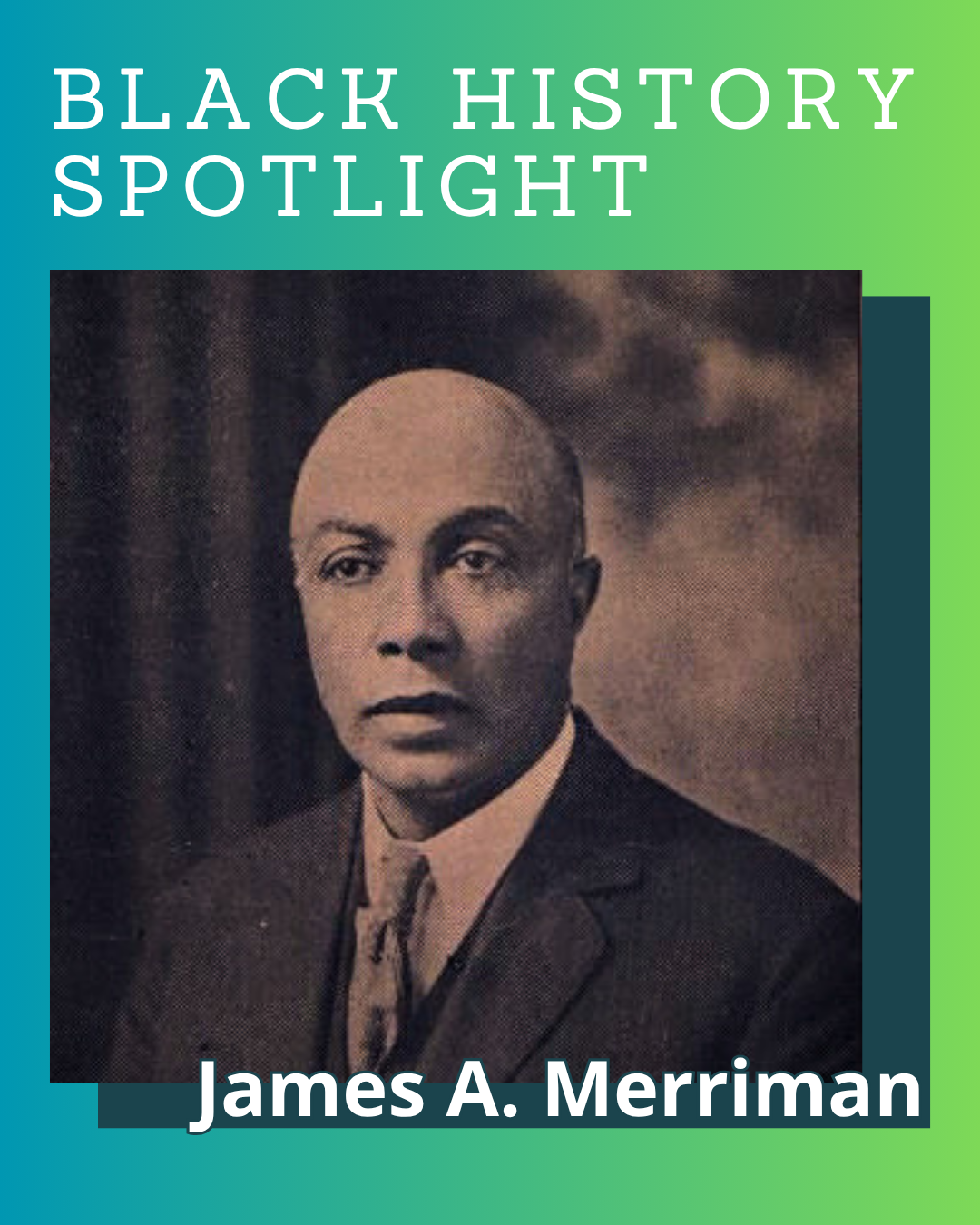
James A. Merriman was a physician, civic leader, newspaper publisher, and Portland’s first Black doctor. James was born in Camden, Alabama in 1870. His parents were sharecroppers from North Carolina, and could not read or write.
Not much is known about James’s early years, but he attended school and then chose to pursue higher education. He enrolled at Talladega College, a historically Black college in Alabama, and graduated in 1891. James then relocated to Chicago to pursue a career in medicine. In 1902, at 32, he graduated from Rush Medical College at the University of Chicago. He was the university’s only Black graduate that year.
Portland, Oregon was connected to the east by rail in the late 1880s. The city’s Black population grew rapidly afterward, as Black workers from around the country were recruited to work for the railroad companies as porters, waiters, cooks, and more. Many of these Black newcomers decided to remain in Portland permanently. At the turn of the century, Portland’s Black population was nearly 1000 people, and hotels, restaurants, and barbershops had opened to cater to the new Black clientele.
Portland lacked a Black doctor, however. At the time, White doctors frequently turned away Black patients, meaning Black Portlanders had few options for health care. Union Pacific Railway hired James in Chicago right after graduation, and sent him to Portland in 1903. There, he became the first professional Black doctor in Portland, and perhaps in all of Oregon. He opened a medical practice on Larrabee Avenue, which he later shared with another physician, Dr. Stanley Lucas of Kingston, Jamaica.
For the next 27 years, Dr. Merriman served Portland’s Black community. He lived in a large home on NE Prescott Street, and had many civic responsibilities outside of his medical practice. In 1903, he co-founded the Black-owned newspaper, The Advocate. He also co-founded and served as editor of the Portland Times newspaper from 1913-1926. His name appears often in the local press throughout the 1910s-1920s, serving as a moderator of local forums, as the president of a literary society, and even as the director of church plays.
The United States entered World War I in 1917 when Dr. Merriman was in his late forties. Too old to serve, he worked as a “Four Minute Man,” giving speeches and information on the war effort in public settings on behalf of the United States government. In 1918, he was appointed to the Volunteer Medical Service Corps, though he was not sent overseas.
Dr. Merriman also served as a mentor to Dr. DeNorval Unthank, a longtime Black physician in Portland who had also been recruited by Union Pacific Railway. When Dr. Merriman left Oregon for Arizona in 1931, Unthank became Portland’s sole Black doctor. Dr. Merriman continued to work as a physician in Phoenix for another 17 years before passing away at age 76 in 1946.