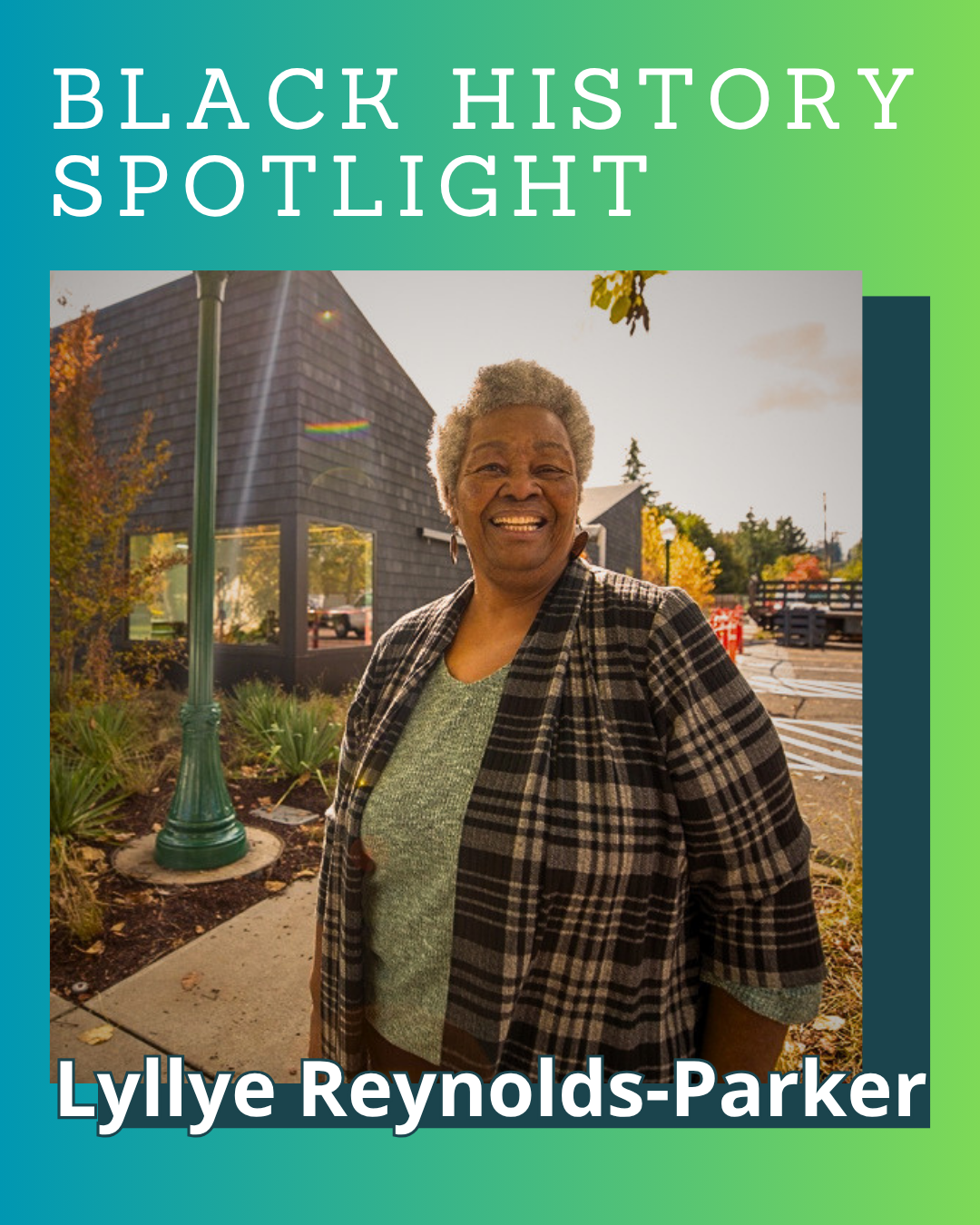
Lyllye Reynolds-Parker was an educator and an important civil rights champion for Eugene, Oregon’s Black community. Lyllye Reynolds was born in Eugene in 1946, and was said to be the first Black child born at the city’s Sacred Heart Hospital. Her parents, Sam and Mattie Reynolds, relocated to Eugene from Louisiana in 1942 for railroad opportunities. The Reynolds were one of the first five Black families to settle in Eugene.
Due to racist laws which prevented Black Americans from residing in Eugene, the Reynolds and other Black families created an improvised settlement just outside the city limits on the east bank of the Willamette River. The small community had homes, and even a church—St. Mark’s Episcopal Church—but no running water.
Lyllye spent her earliest years in this community, but in 1948, the settlement was demolished for the construction of the Ferry Street Bridge. Most Black residents, including the Reynolds, relocated to West 11th Street.
In 1964, Lyllye became one of the first three Black students to graduate from Sheldon High School. There, Lyllye experienced discrimination from students and from teachers; after telling her guidance counselor that she wanted to be the next Thurgood Marshall, the counselor told her to pursue something more realistic. Undeterred, Lyllye became a civil rights leader from an early age. She served as Vice President of the Eugene Chapter of the Student Nonviolent Coordinating Committee (SNCC) in 1964, and became a member of the Eugene chapter of the Congress of Racial Equality (CORE) which was founded by her mother in 1966.
Lyllye worked, married, and started a family. She spent eight years as an employee of Southern Pacific Railroad, and raised two children with her husband Joe Parker. In 1986, at 40 years old, she decided to enroll at the University of Oregon. She graduated with a degree in sociology in 1991. Soon after, the university hired her to work as a counselor in the Multicultural Center. For the next 17 years, Lyllye mentored and advised hundreds of students, most of them Black, Indigenous, Asian, and Latino. Her work made her a beloved member of the UO faculty.
Lillye retired in 2012. In 2019, the University of Oregon Board of Trustees unanimously voted to name the university’s new Black Cultural Center in her honor. She was the first Black woman, and the first living person, to have a building named for them on the UO campus. Lyllye Reynolds-Parker passed away in 2024 at the age of 78.