
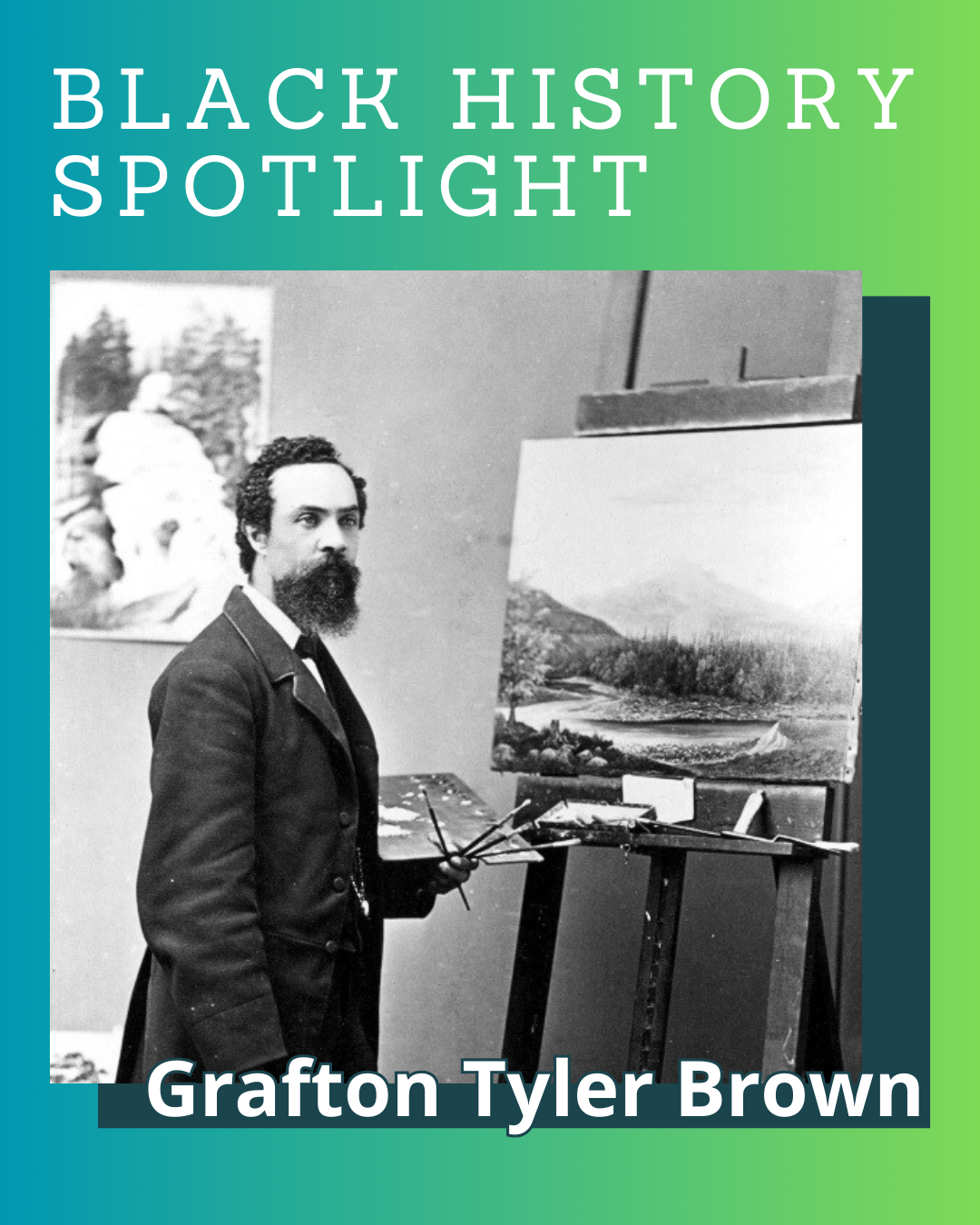
Grafton Tyler Brown was the first Black professional painter in the Pacific Northwest. Brown was born in Harrisburg, Pennsylvania in 1841 to free Black parents from Maryland. The Brown family’s children were able to attend school and pursue professional careers. As a teenager, Grafton was working for a Philadelphia lithographer. He left Philadelphia for San Francisco in 1858 to study to become a western painter.
Grafton Brown’s light complexion allowed him access to spaces typically off limits to Black Americans. He occasionally identified as White within San Francisco’s business community. After a brief stint as a hotel steward, Brown landed a job working for lithographer Charles Kuchel in the city’s “Printer’s Row” on Clay Street. Kuchel commissioned Brown to illustrate scenes from California’s gold rush towns. From there, Brown was sent to Virginia City, Nevada, a boomtown that emerged following a massive discovery of silver called the Comstock Lode. Brown’s 1861 birds-eye portrait of Virginia City was the first ever illustration of the town. Birds-eye maps became a signature style for Brown; he would go on to draw birds-eye views of fifteen Pacific Coast cities for use in advertisements and tourism promotions.
When Charles Kuchel died in 1864, Brown purchased the lithography business and renamed it “Grafton T. Brown & Co.” His first major commission was from the State of California, to create lithographs for seven maps of the San Francisco Bay tidelands and marshes. Brown’s company would ultimately produce products ranging from stock certificates to playbills.
In 1878, after twenty years of making commercial art, Brown turned exclusively to painting for artistic purposes. He sold the business and moved to Victoria, BC, where he painted landscapes. Around 1884, Brown moved to Portland, Oregon. Portland became a base for his extensive travels across the Pacific Northwest. Brown spent over a year working on paintings of Mount Rainier, along with works depicting Mt. Hood and Mt. St. Helens. In Portland, Brown became the secretary of the Portland Art Club, and competed in the club’s semi-monthly contests opposite European-trained painters.
In 1887, Brown left Oregon for Yellowstone National Park, where he painted the park’s canyons, waterfalls, and geysers to sell to tourists. He remained there until 1892, when he relocated permanently to St. Paul, Minnesota to work as a draftsman for the Army Corps of Engineers. Brown died there in 1918 at the age of 77.
Grafton T. Brown remains lesser-known among the many artists who painted the American West in the late 19th century. However, his status as an early Black painter and lithographer has earned him posthumous recognition. Today his paintings are in the collections of the Smithsonian American Art Museum, Los Angeles County Museum of Art, Royal British Columbia Museum, and Portland Art Museum.