
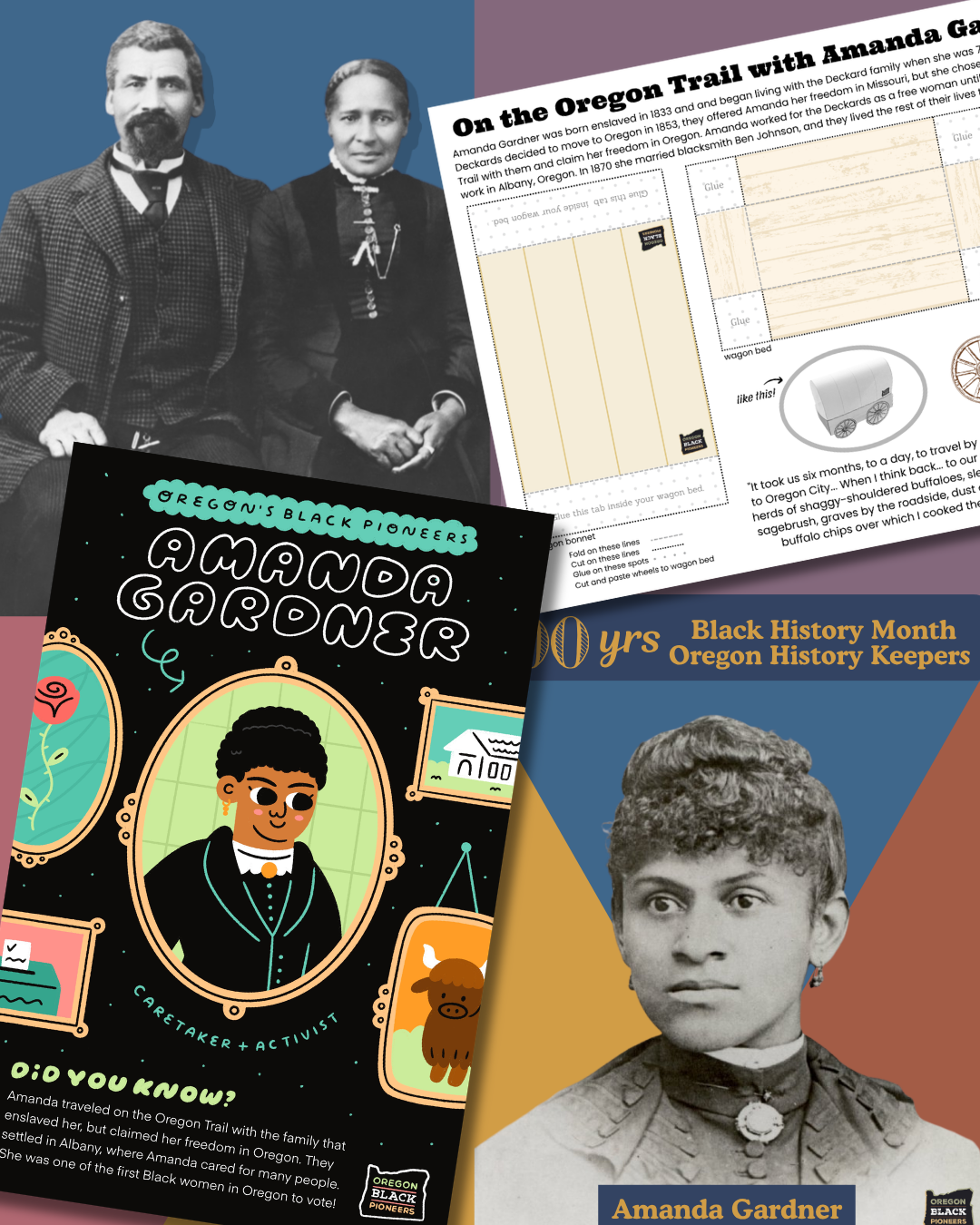
Who is Amanda Gardner Johnson? Journalist, historian, and author Fred Lockley wrote Conversations with Pioneer Women to gather the stories of women who traveled to the Pacific Northwest in search of a new life. Amanda Gardner was one of those women. These interviews first appeared in The Oregon Journal in 1918. This remarkable firsthand account told to Fred Lockley directly by Amanda herself is a very rare opportunity to hear a formerly enslaved woman’s Oregon Trail story in her own words.
Conversations with Pioneer Women by Fred Lockley (1918)
Amanda Gardner Johnson
Calapooia Street is in Albany, Oregon. In the center of a block, beside a crystal-clear stream, stands an old fashioned house –a house of the middle ‘70’s. Thick-branched odorous cedars surround the house. Beside the walk, like green-painted golf balls, are newly fallen black walnuts, still in their protective coverings, which, when crushed, smell like woodland incense.
I knocked at the door. A pleasant-faced woman answered the summons and, responding in the affirmative to my question as to whether Amanda Johnson lived there, she invited me into the parlor, where enlarged photographs hang on the wall, and called to someone in the kitchen, “Amanda, there is a gentleman here, to see you,” A moment later Mrs. Johnson came in, with brisk step. Her eyes were clear, her hair was white, and she was the personification of neatness.
“I am not much accustomed to being interviewed, but I will do the best I can to answer your questions. I was born at Liberty, Clay County Missouri, August 30, 1833. My father and mother were born at Louisville, Kentucky.
“No sir, I was never sold nor bartered for. I was given as a wedding present to my owner’s daughter. I belonged to Mrs. Nartcy Wilhite. She was married, after her first husband’s death, to Mr. Corum. Mrs. Corum was the grandmother of Miss Maud Henderson, who answered your knock at the door, and the great-great-grandmother of Mrs. E. M. Reagan, whose husband owns the Albany Herald.
“I have known seven generations of the family. I knew [my] owner, Mrs. Corum, and her father. Mrs. Corum gave me to her daughter, Miss Lydia, when she married Anderson Deckard. My new owner was the third generation and I helped rear her children and grandchildren. That is five generations, and yesterday I held a baby in my arms that is the grandson of one of these grandchildren, so that makes seven generations I have known.
“I had five brothers and six sisters. None of them was sold like common Negroes. They were all given away as wedding presents to relatives of the family when the young folks got married.
“The thought of being ‘sold down South’ was always a cloud that shadowed the happiness of the slaves. A man would drink and lose his money or he would be unlucky at cards and would have to sell some of his slaves. I have often attended auctions of slaves when I was a girl, back in Missouri. They are very much like auctions of any other stock, except that the men that were buying the Negroes would ask them questions to see what they had done and were best fitted for. They would feel their muscles and look them over to see that they were sound. Usually the slaves sold for $500 to $1500, depending upon age and condition. A strong young field hand would bring $1000 to $1200, while a handsome young Negro woman would often sell for $1200 to $1500 if she had attracted the liking of some white man. Usually house servants commanded a better price than field hands.
“In 1853, my owners decided to come to Oregon. A merchant, hearing that my master was to go to Oregon Territory, where slaves could not be held, came to Mr. Deckard and said ‘I will give you $1200 for Amanda. You can’t own her where you are going, so you might as well get what you can out of her.’
“I had been given to Miss Lydie, his wife, when I was seven, and I was 19 then. Mr. Deckard said, ‘Amanda isn’t for sale. She is going across the plains to the Willamette Valley for us. She has has the care of our four children. My wife and children like her. In fact, she is the same as one of our family, so I guess I won’t sell her.’
“Mr. Deckard asked me if I wanted to be given my freedom and stay where I had been raised, and where all my people lived, but I was afraid to accept my liberty, much as as I would have liked to stay there. The word of a Negro, even if a free Negro, was of no value in court. Any bad white man could claim that I had been stolen from him and could swear me into jail. Then, in place of keeping me in jail, he could buy my services for the time I was sentenced for, and by the time I had served my time for him he could bring up some other false charge and buy my services again, and do whatever he wanted to me, for Negroes were the same as cows and horses and were not supposed to have morals or souls. I was afraid to accept my liberty, so I came to Oregon with my owners.
“It took us six months, to a day, to travel by ox team from Liberty, Missouri, to Oregon City. We started from Clay County, March 13, 1853, and got to our destination September 13. When I think back nearly 70 years to our trip across the plains I can see herds of shaggy-shouldered buffaloes, slender-legged antelopes, Indians, sagebrush, graves by the roadside, dust and high water and the campfire of buffalo chips over which I cooked the meals.
“Lou Southworth, also a slave, crossed the same year I did. So did Benjamin Johnson, another slave who later became my husband. There are two women living in Albany now who were in our emigrant train–Mrs. Mary Powell and Ella Blodgett. They were little girls then and their name was Summerville. We camped at Oregon City until October, while Mr. Deckard went on horseback down towards Linn County looking for a donation land claim. He took one between Albany and Peoria. In those days, when boats ran the river, Peoria looked as if it would be a good-sized town.
“I went to work for a man named James Foster. He was a merchant, but later started the Magnolia Mills and made flour. When I left Missouri you could buy eggs for three to five cents a dozen, bacon at five to six cents a pound, butter at twelve to fifteen cents a pound, and corn for twenty cents a bushel, and you could hire men for fifty to seventy-five cents a day, so when I was paid $3.50 a week I decided I had come to a land of promise, a land that was flowing with milk and honey.
“I was baptized when I was 14 years old by Mr. James, a Baptist minister. You have often heard of his son Jesse. Jesse James got into trouble holding up trains and doing all sorts of mischief.
“On April 12, 1870, a little over 50 years ago, I married Ben Johnson. The Reverend T. J. Wilson, who now lives in Eugene, performed the ceremony. I was married at Mr. Foster’s house and they gave me a fine wedding.
“Yes, I never get over the feeling that my first duty is to family. Whenever any of the Deckards are sick I always go to nurse them and to take care of them, for, you see, they are my people, and the only people I’ve got. I am 88 years old, but I am strong and well. Most of our family have done themselves proud. Mr. Reagan, the editor of the Albany Herald, married into our family. [illegible] there a few nights ago.
“Ho, I don’t suppose there are many other colored people in Oregon who have been slaves, but I have been free since I was 20, and that’s nearly 70 years ago.”