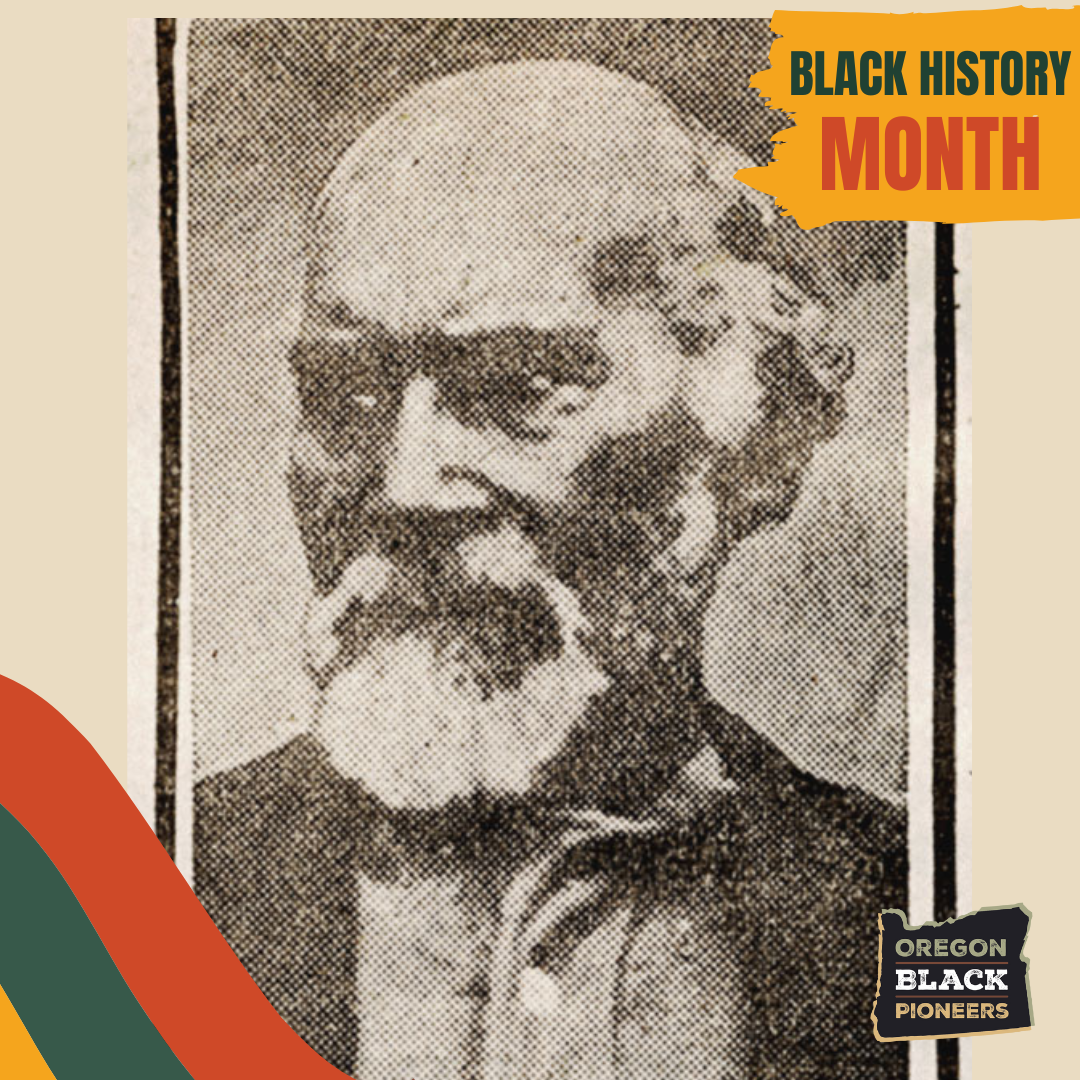
It’s Black History Month! We’ve got good things going on: History Spotlights featuring some of Oregon’s noted Black history makers, speaking events, and a takeover of Oregon Coast Visitors Association’s Instagram.
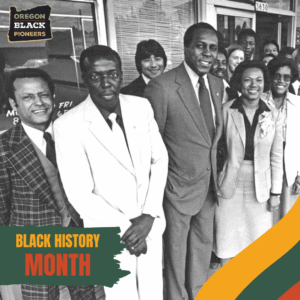 Oregon Black History Spotlight: The staff of Portland Urban League and William Hillard (far left) the first African American editor at The Oregonian, with National Urban League President Verne Jordan (front row, third from left), Portland ca. 1970s
Photo Credit: Urban League of Portland collection, Oregon State University Special Collections Archives & Research Center, via Oregon Digital.
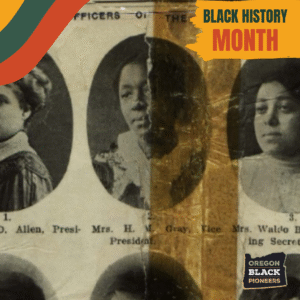 Oregon Black History Spotlight: Katherine Gray
Katherine Gray was one of Portland’s most prominent Black activists during the 1910s-1920s. Katherine and her husband Harry moved to Oregon from New York in 1895. They bought a home in North Portland and Katherine worked as a laundress.
Katherine became a leading voice in the movement for women’s suffrage. In 1912, she helped form the Colored Women’s Equal Suffrage League, serving as the group’s Vice President. Her daughter Edith was the treasurer.
The suffrage campaign was a success, but Katherine was not done. She served as President of Portland’s Colored Women’s Council in 1914, the Oregon Federation of Colored Women’s Clubs in 1917, and Colored Women’s Republican Club in 1920. She was also active in the temperance movement and joined Beatrice Cannady in opposing the screening of the film “Birth of a Nation” in Portland. Katherine devoted her free time to the choir of the First Zion AME Church, a church she had helped to found.
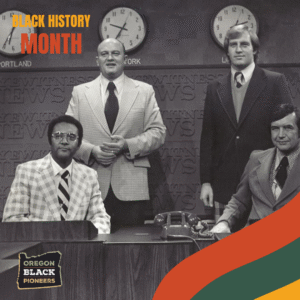 Oregon Black History Spotlight: Dick Bogle
Dick Bogle was a landmark reporter and politician. Born in Portland in 1930, his father descended from an early Oregon pioneer family and his mother was well known writer and activist Kathryn Hall Bogle. Dick attended OSU and Vanport College before taking a job as a music reporter at @theoregonian in 1952. From 1959 to 1967, Bogle worked as a Portland police officer, but continued his newspaper work.
@katutv hired Bogle to be a correspondent, the first Black on-air reporting in Portland history. In 1973, he became the anchor for the channel’s “Eyewitness News” program. In 1984, Dick Bogle ran to replace outgoing Portland city councilor Charles Jordan and won. He would be reelected to this same office in 1988.
Bogle endeavored to represent the interests of Black Portland during his time in office and remained a prominent local figure for years after. He resumed his reporting on jazz music and hosted a radio show. From 2008-2010 Bogle was a volunteer member of Portland Police Bureau’s cold case unit, working to try and resolve unsolved murders.
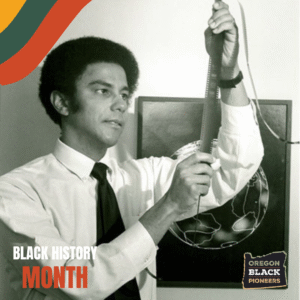 Oregon Black History Spotlight: Warren Washington
Warren Washington is a groundbreaking climate scientist and Nobel Prize winner. He was born in Portland in 1936 to college-educated parents. He attended Jefferson High School and served as the president of the school’s student NAACP. Warren was drawn to science, and his teachers encouraged him to pursue higher education.
Warren enrolled at Oregon State and earned a bachelor’s degree in physics in 1958. He then re-enrolled at OSU and received a master’s in meteorology. Warren then left Oregon to pursue a PhD at Penn State.
In 1963, Warren joined the National Council on Atmospheric Research as a research scientist. In addition to breaking racial barriers, Washington set new frontiers in climate science. He helped develop the first computer-based models of atmospheric trends.
In a career spanning more than 50 years, Warren Washington has published over 150 articles and authored two industry reference books. In 2007, his study on the impacts of climate change was awarded the Nobel Peace Prize, which he shared with a team of other NCAR researchers.
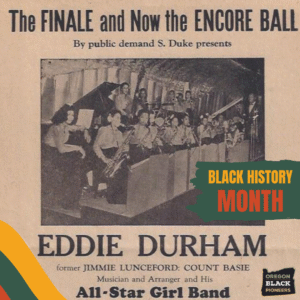 Oregon Black History Spotlight: Stanton Duke
Stanton H. Duke was an early music promoter during Portland’s jazz years. Born in 1907 in Illinois, he came west to Oregon as a railroad dining car waiter in the late 1920s. In 1930 he married Rozelia Phelps, a member of the first Black family to live in Bend.
As Stanton traveled across the country for work, he connected with Black musicians, encouraging them to perform in Portland. Soon he decided to make this his living. In 1934, Stanton joined Cole “Pops” McElroy to form Bronze Attractions, a promotional company that brought Black jazz talent to McElroy’s Spanish Ballroom and other venues across Portland.
Stanton would place fliers all down Williams Ave to announce his acts. “S. Duke Productions” was responsible for bringing some of the biggest names in jazz to Portland during the 1930s and 1940s, including Cab Calloway, Billie Holliday, Ella Fitzgerald, Duke Ellington, and Nat King Cole. In 1949 Stanton and Cole McElroy’s son Burt sponsored the first interracial dance at the Ballroom.
In the 1950s, Stanton and Rozelia’s son Clarence became the first Black sportscaster in Oregon, working for KGON in Oregon City.
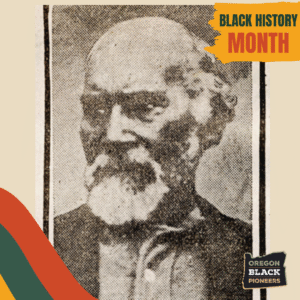 Oregon Black History Spotlight: Bill Rumley
William “Bill” Rumley was a formerly enslaved pioneer of Oregon’s south coast. He was born into slavery around 1830. In 1850, his enslaver took him to California on the promise of freedom. When it became clear to Bill that he would not be freed, Bill escaped.
Bill continued mining in Northern California and eventually in Southern Oregon. He married a Karok woman in 1864 and they had one child. The family appears in the 1870 census for Curry County near Agness, at a location later called “Rumley Hill.”
Bill was well known as a hunting guide, famous for his cooking and storytelling. He was a friend to many, calling on neighbors, hosting parties, and loaning money. A local woman who knew him wrote, “everyone loved Uncle Bill. He had no bad traits. He was a very humble man, and very kind….He was always laughing when I saw him.”
In 1916, at age 86, Bill jokingly enrolled in a correspondence school program for horse breaking! Bill was named as a county election judge for the Big Bend precinct multiple times, and in 1919 he became the oldest known person in Oregon to secure a Homestead claim.
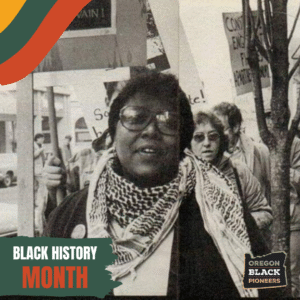 Oregon Black History Spotlight: Bahati Ansari
Bahati Ansari was a dedicated educator and Eugene community activist. Bahati was born outside of Chicago in 1948, and moved her family to Eugene in 1974 to escape their violent neighborhood. Soon she became involved with Clergy and Laity Concern, a group focused on nuclear non-proliferation.
At school, Bahati’s sons experienced racist harassment from their classmates and teachers. In 1983, she removed her sons from school in protest. While the school district threatened police involvement, she rallied legal and political support. Rosa Parks even sent her personal bodyguards to escort Bahati to her next meeting with the school principal.
Bahati was able to convince the district to create “Racism Free Zones” in Eugene schools. This involved anti-racist trainings for staff and increased resources for students of color. The program grew into a nationwide initiative under her leadership. She also led multicultural after school programs in Eugene during the 1990s, and served on the Eugene Human Rights Commission from 2001-2003.
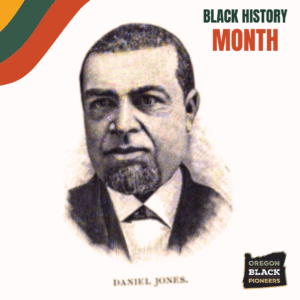 Oregon Black History Spotlight: Rev. Daniel Jones
Daniel Jones was an early Black religious leader in Salem. He was born free in Pennsylvania in 1830, and at just 10 years old, he was sent to Philadelphia to find a job. He trained as a barber and worked that trade during his teenage years.
In 1849, Daniel went west to California during the gold rush. After five years as a miner in Northern California, he settled in Jacksonville, Oregon where he resumed his work as a barber and occasionally taught school. While there, he married and raised four children.
Around 1870, the family relocated to Salem where Daniel enrolled in Willamette University Prep Department’s divinity program. Although the Prep Department was equivalent to high school studies, he became the first Black student to attend Willamette University at any level.
Now a Methodist minister, Daniel was the Oregon delegate to a national Methodist convention in 1873. That same year, he moved back east with his family. Jones served as a minister in New Jersey, Ohio, Indiana, and Kentucky before his death in 1891.
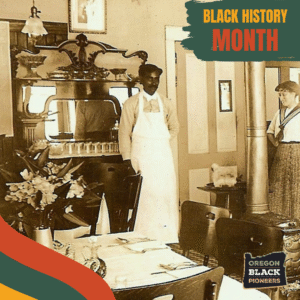 Oregon Black History Spotlight: Alvin McCleary
Alvin McCleary was a longtime resident of Oregon’s central coast in the late 19th and early 20th centuries. He was born in 1866 in San Francisco to an Afro-Caribbean father and an Indigenous mother. Orphaned as an infant, he was adopted by a Black woman named Mary Cooper.
Mary and young Alvin moved to Salem around 1870. There, in 1873, Mary met and married Louis Southworth, a formerly enslaved miner and blacksmith. The family of three relocated to Buena Vista, and then to Alsea in 1880.
As an adult, Alvin found work in the fishing industry. Starting in 1887, he worked in Waldport and Newport canneries. He then worked as a commercial salmon fisherman from 1893-1913. In 1906 Alvin opened a Newport butcher shop.
In the 1910s, Alvin returned to Waldport, where he managed the Wakefield Hotel and its restaurant for many years. He was elected to Waldport city council in 1934. He owned his own home in town, which he lived in until shortly before his death in 1951.